
Southern Sierra Partnership
What is SSP?
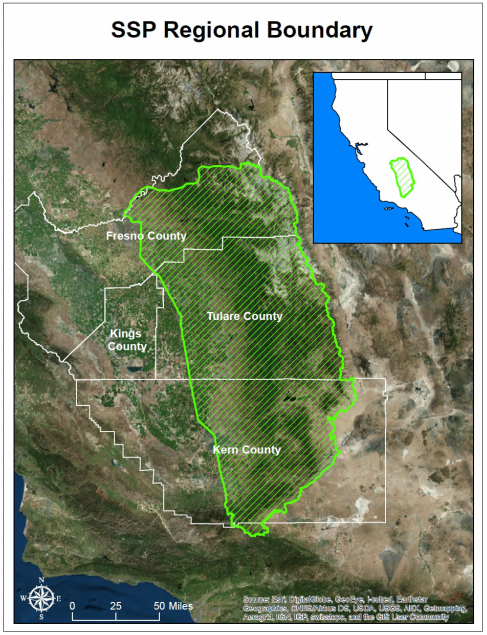
|
The Southern Sierra Partnership (SSP) is an alliance of business and conservation organizations working to protect lands, livelihoods and communities. Our member organizations, including Sequoia Riverlands Trust, Audubon California, the Sierra Business Council, The Nature Conservancy and Tejon Ranch Conservancy, have conserved hundreds of thousands of acres of habitat, working ranches and farmland. We have also developed a collaborative, science-based vision for regional conservation and a policy outreach platform to help realize it. |
Making a Difference
Collaborative Efforts
Conservation Planning
In 2009 and 2010, SSP spearheaded a collaborative conservation assessment of the entire region. Combining the latest climate science with detailed mapping of biodiversity, ecosystem services and land uses, and incorporating the input of numerous land management agencies, SSP sought to identify conservation opportunities that would allow the region as a whole to adapt to a changing climate. The resulting Framework for Cooperative Conservation and Climate Adaptation for the Southern Sierra Nevada and Tehachapi Mountains has gained national recognition as a model of science-based conservation planning.
Making Connections
To implement the vision laid out in the Framework, SSP members have protected hundreds of thousands of acres of rangeland in the Southern Sierra foothills, and are working to connect these properties with farmland and riparian habitat on the Valley floor. This will not only help the region adapt to climate change, but also preserve the watersheds and other natural systems that make agriculture possible on the Valley floor.
Economic & Sustainable Development
In 2012 and 2013, Adam Livingston of Sequoia Riverlands Trust examined the connection between land use and economic outcomes in Fresno, Tulare, Kings and Kern Counties. The resulting report–Paths to Prosperity for the Southern Sierra and Southern San Joaquin Valley: Capitalizing on the Economic Benefits of Land Conservation and Compact Growth—is helping to build a regional consensus in favor of sustainable development.
Renewable Research
SSP members are working with elected officials, planners and others to minimize conflict between renewable energy projects and regional conservation goals. In 2013, the Conservation Biology Institute (at the time, an SSP member) released its Decision Support for Conservation in the Tehachapis and Southern Sierra Nevada. The Decision Support uses research, mapping and modeling to identify the most conservation-friendly areas for wind power and other developments.
Strategic Planning
Today, SSP is actively engaged in land use policy throughout the region, including the development of Sustainable Communities Strategies as mandated under state climate change legislation and work on County and City-level General Plan Updates.
Member Organizations

Audubon California is a field program of the National Audubon Society, a nonprofit that has worked to conserve and restore natural ecosystems for over a century. At Kern River Preserve and elsewhere, it protects birds, other wildlife and habitat for the benefit of humanity and the Earth’s biological diversity.

Sequoia Riverlands Trust (SRT) is a regional, accredited land trust that inspires love and lasting protection for important lands. Working with landowners, conservationists and other partners, SRT has protected more than 27,000 acres of habitat and farmland for future generations. SRT also owns and manages six preserves, educates the public about conservation and stewardship, and is actively involved in land use policy.
The Sierra Business Council (SBC) is a member-based organization of over 700 individuals and businesses committed to pioneering innovative solutions in the Sierra Nevada. By helping businesses and communities adapt to changes in the region’s environment, economy and population, SBC seeks to foster community vitality, environmental quality, economic prosperity and social fairness in the Sierra Nevada.
Tejon Ranch Conservancy was created in 2008 to preserve, enhance, and restore the native biodiversity and ecosystem values of the Tehachapi Range for California’s future generations. It is responsible for the permanent protection of approximately 240,000 acres of the 270,000-acre Tejon Ranch, and works with Tejon Ranch Company and others to promote long term, science-based stewardship of the Ranch.
The Nature Conservancy works around the world to protect ecologically important land and waters. Its conservation efforts emphasize science, pragmatic solutions and partnerships, and have saved more than 119 million acres of land worldwide. In California, The Nature Conservancy has protected nearly 1.5 million acres, including key habitat in the Southern Sierra and Tehachapi Mountains.
Key Participants
SSP Coordinator
- Adam Livingston (Sequoia Riverlands Trust)
Other Key Participants:
- Cara Lacey and Zach Principe (The Nature Conservancy)
- Mitchell Coleman (Tejon Ranch Conservancy)
- Steve Frisch (Sierra Business Council)
- Reed Tollefson (Audubon California)
Publications
SSP’s publications present a comprehensive vision for protecting land and livelihoods in the Southern Sierra and Southern San Joaquin Valley. They include a nationally recognized, science-based framework for climate change adaptation, a compelling report on the economic case for conservation and compact growth, a valuable tool to minimize conflict between wind energy and land protection, and a management plan covering more than 200,000 acres in one of the most important habitat linkages in the state.
Framework
SSP’s Framework for Cooperative Conservation and Climate Adaptation for the Southern Sierra Nevada and Tehachapi Mountains has gained national recognition as a collaborative, science-based strategy for regional adaptation to climate change. Among its contributions are the following:
- A detailed inventory of the region’s biodiversity, natural resources and land use patterns;
- Research on the distribution of forage production, aquifer recharge potential and other ecosystem services across the region;
- An examination of how climate change is likely to affect specific species, ecosystem services and the region as a whole;
- Spatially explicit findings on the habitat corridors needed to protect biodiversity as the climate changes; and
- A detailed assessment of conservation priorities from the peaks of the Sierra to the Valley floor.
Economic Study
Paths to Prosperity for the Southern Sierra and Southern San Joaquin Valley: Capitalizing on the Economic Benefits of Land Conservation and Compact Growth, by Adam Livingston, makes an economic case for protecting land and strengthening communities in Fresno, Tulare, Kings and Kern Counties. In addition to the full report, SSP offers factsheets to summarize particular findings:
- The Land Base Is the Foundation of the Region’s Economy
- Land Conservation and Compact Growth: the Keys to Water Availability, Water Treatment and Flood Control
- Saving Taxpayer Dollars on Infrastructure, Public Health and Firefighting Costs
- Helping Households and Communities Recover from the Housing Crash
- Land Conservation and Compact Growth Can Reduce Greenhouse Gas Emissions
- Revitalizing our Cities to Increase Tax Revenue without Raising Tax Rates
As Paths to Prosperity shows, conservation is essential to the effort to build a more resilient economy in the Southern Sierra and Southern San Joaquin Valley.
Sustainable Communities Strategies and Conservation
Sustainable Communities Strategies (SCSs), which link land use, transportation and climate policy, are designed to reduce per capita greenhouse gas emissions while providing benefits ranging from improved air quality and expanded transportation options to revitalization of city centers and investment in disadvantaged communities. Because conservation of natural and working lands is essential to achieving these goals, most SCSs include policies, objectives or implementation measures relating to conservation, and many take innovative approaches that may be of use to other regions.
Sustainable Communities Strategies and Conservation: Results from the First Round and Policy Recommendations for Future Rounds, prepared by Adam Livingston for The Nature Conservancy, seeks to build on these successes and help planners achieve more robust results in future rounds. To do so, it surveys conservation measures in existing SCSs, along with conservation-related proposals that were made but not adopted in each region, and then offers a selection of model policies and best practices for future SCSs.
Renewable Energy - The Decision Support for conservation
The Decision Support for Conservation in the Tehachapis and Southern Sierra seeks to minimize the conflict between wind energy and conservation. Designed by the Conservation Biology Institute during its time as an SSP member, the Decision Support provides science-based guidance on the best locations for renewable energy development in the windy Southern Sierra and Tehachapi Mountains. Using this guidance, planners, conservationists and renewable energy entrepreneurs can work together for the benefit of the region.
Land Management - The Ranch-wide management plan
The Ranch-wide Management Plan (RWMP) for conserved lands at Tejon Ranch provides a blueprint for stewardship, restoration and enhancement of more than 200,000 acres in one of the most important habitat linkages in the state. Prepared by Tejon Ranch Conservancy with the assistance of conservationists, scientists, ranchers and many more, the RWMP seeks to balance the activities of a working ranch with the long term protection of biodiversity. This first-of-its-kind plan is notable not only for the scale and ecological significance of Tejon Ranch, but also for stewardship and restoration approaches that can inform land management across the region.
Among its contributions are the following:
- An inventory of what is currently known of the Ranch’s ecosystems;
- A set of science-based conservation goals;
- Proposed management actions to restore and enhance habitats;
- Best management practices for specific land uses in areas covered by the RWMP; and
- A five-year public access plan.
For more info, visit http://www.tejonconservancy.org/
Contact Us
If you have questions or comments, or would like to help us make a difference, SSP wants to hear from you!